
Trees of Knowledge: Artistic Visualisation of the Explanatory Tantra
On June 30, 14.30-15.30 (CEST) a zoom meeting will take place which provides more information. Attendees will have the opportunity to ask questions of any kind and actively engage in the knitting initiative.
Join here via Zoom (no registration necessary):
https://univienna.zoom.us/j/69198850742?pwd=3jCOvhoUHb2vczUGSpu3IDs7cru5T0.1
Meeting ID 691 9885 0742, Code 565791
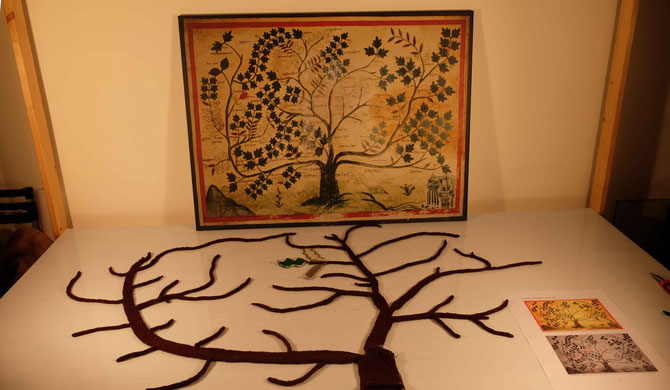
Knitted tree structure on templete by Katharina Sabernig: Photo: Mili Badic
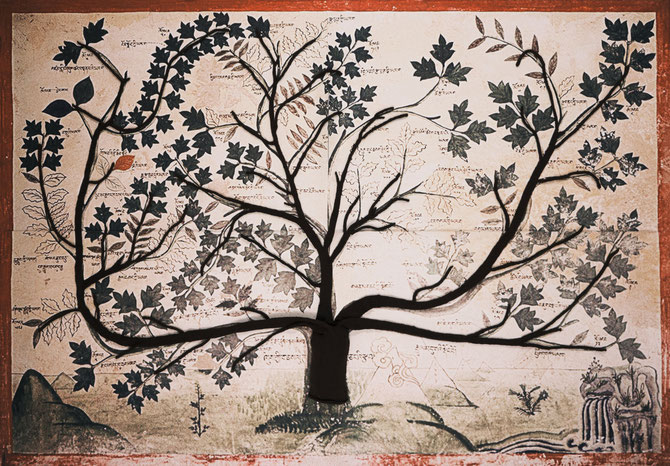
Tibetan medicine possesses an immensely rich and vibrant history of visual and educational representation. This video presents the concept for a collaborative project to transform traditional tree-metaphors for the second part of the Rgyud-bzhi, the core compendium of Tibetan medicine, into a large-scale, three-dimensional textile installation created through a community-based ‘crowd-knitting’ event. The project was originally inspired by murals depicting the Explanatory Tantra of Tibetan medicine at Labrang Monastery (Gansu Province, China), which I examined at the beginning of my studies of Tibetan medicine. The idea is to re-create in the form of a knitted artwork these tree metaphors, which go back to a text written in the seventeenth century by Lobsang Chödrak, the personal physician of the Fifth Dalai Lama. The murals served as mind maps for memorising the traditional curriculum content. There are a total of 30 trees, four bushes, 78 trunks, 385 branches, and thousands of leaves. I analysed these scientifically in an earlier project (FWF no. P22965-G21; https://utheses.univie.ac.at/detail/43079#).
Preparations for this collaborative initiative have already begun in anticipation of the 2026 International Association for Tibetan Studies (IATS) conference in Kathmandu. The project aims to engage a diverse community, including regional practitioners, scholars, patients, and supporters, in the creative process. The final results will be presented performatively at the conference of the International Association for the Study of Traditional Asian Medicine (IASTAM) in Singapore in 2027. I am currently serving as Secretary General of IASTAM, developing practical guidelines to facilitate participation. This video invites viewers to participate and explains these methods in the context of the project's collaborative and educational implementation.
Creation of Tree of Anatomy - Chapter 4 of the Explanatory Tantra
© Katharina Sabernig
